
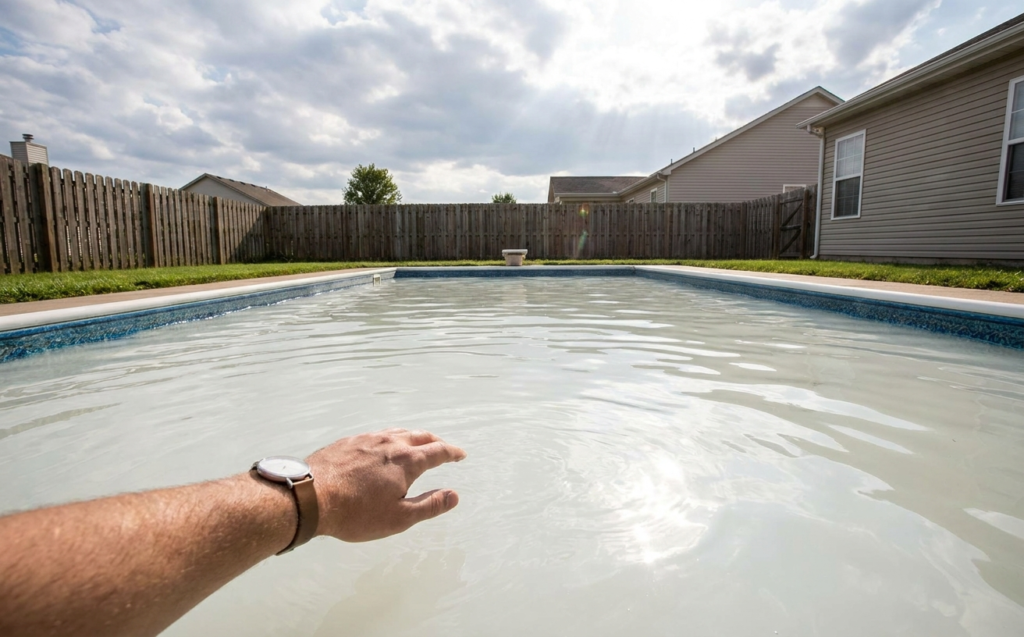

Your pool was crystal clear on Friday. By Sunday afternoon, it looks like someone poured milk into it. The water is not green, so it is probably not algae. It is just dull, hazy, and stubbornly opaque.
This is one of the most frustrating things a pool owner can face, because the usual fixes do not seem to work. You add chlorine. Still cloudy. You run the filter overnight. Still cloudy. You shock the pool. Still cloudy.
The reason nothing works is that you are treating the symptom instead of the cause. Cloudy water is never the actual problem. It is the result of a problem. And until you identify that underlying cause, the haze will keep coming back.
Three Root Causes Behind Every Cloudy Pool
Despite how it looks, cloudy water almost always comes from one of three sources. Figuring out which one applies to your pool is the first step toward fixing it permanently.
Cause One: Filtration Failure
Your filter is the kidney of your pool. When it is clogged, damaged, or undersized, it cannot remove the microscopic particles that cause haze. If your filter pressure has been running high, or if you cannot remember the last time you cleaned or backwashed it, start here.
Cartridge filters need periodic cleaning and eventual replacement. Sand filters need backwashing when pressure rises eight to ten psi above normal. DE filters require backwashing and fresh DE powder after each cycle. Neglecting any of these routines allows fine particles to pass right through and back into the pool.
Cause Two: Chemical Imbalance
When pH, alkalinity, or calcium hardness drift out of range, minerals can precipitate out of solution and create a fine suspension that looks exactly like cloudy water. This is especially common after a heavy rain or a large water replacement.
High pH is the most frequent chemical culprit. When pH rises above 8.0, calcium carbonate begins to form microscopic crystals that float in the water and scatter light. The result is that familiar milky appearance.
Testing your water is the only way to confirm this. If your pH is high and your calcium hardness is above 400 ppm, mineral precipitation is almost certainly the source of your cloudiness.
Cause Three: Dead Algae and Organic Debris
Sometimes the cloudiness is the aftermath of an algae kill. You shocked the pool, the algae died, but the dead cells are still floating in the water as fine particles. The chlorine did its job, but the filter has not caught up yet.
This type of cloudiness often appears after a shock treatment and can take several days of continuous filtration to resolve. A clarifier can help by clumping the tiny particles into larger ones that the filter can trap more easily.
The Step-by-Step Fix
No matter which cause applies, the resolution follows the same basic sequence. Test first, then treat the root cause, then polish the water.
If you are dealing with persistent cloudy pool water that does not respond to basic treatment, there may be a more complex issue at play, such as a failed filter media, a hidden algae strain, or a water source with unusual mineral content. Diagnosing the root cause before adding more chemicals saves time and money.
- Test your water for pH, alkalinity, free chlorine, and calcium hardness
- Clean or backwash your filter and run it continuously for at least 24 hours
- Adjust any chemical readings that are outside the recommended range
- Add a clarifier if the water remains hazy after chemistry is balanced
- Vacuum the pool to remove settled particles after the filter has run overnight
Why Clarifiers Work (And When They Do Not)
Clarifiers are polymers that act like microscopic magnets. They attract tiny suspended particles and cause them to clump together into larger clusters that your filter can actually catch. This speeds up the clearing process significantly.
But clarifiers only work when your chemistry is balanced and your filter is functioning properly. Adding a clarifier to a pool with a clogged filter or wildly imbalanced pH is a waste of money. Fix the foundation first.
- Use a clarifier only after testing and balancing your water
- Run the pump continuously for at least 24 hours after application
- Clean or backwash the filter after the water clears to remove trapped particles
- Do not overdose, as too much clarifier can actually make cloudiness worse
Preventing Cloudy Water From Returning
Once your water is clear, keeping it that way requires consistent maintenance. The biggest factor is running your pump long enough each day. Most pools need at least eight hours of circulation during the swimming season.
Test your water twice a week and address small drifts immediately. A pH that creeps up by two tenths is easy to correct. A pH that has climbed a full point requires larger adjustments and creates the conditions for cloudiness to develop.
Keep your filter media in good condition. Replace cartridges according to the manufacturer’s schedule, backwash sand and DE filters regularly, and inspect the system for leaks or bypasses that reduce filtration efficiency.
Clear water is not a happy accident. It is the natural result of proper chemistry, adequate filtration, and consistent attention. When all three are working together, your pool stays sparkling without the need for emergency interventions.